Connections November 23, 2026 (#1261)
MondayYesterday
By Connections Today app
Yesterday’s puzzle in New York.
Start with a hint for one color. The answers stay hidden until you open them.
Hints by color
Yellow line, #1261
-
Hint 1Next stop
A direction for your next guess
-
Hint 2
A more specific clue
Open hint 1 first
-
Category
The name of the group
-
One word
One of the four. The other three stay hidden
Answers for #1261
Each answer lists the four words and why they belong together.
-
Yellow
-
Green
-
Blue
-
Purple
Sources for #1261
Connections November 23, 2026 puzzle notes
For Connections November 23 (#1261), try separating a familiar term into parts and see what each part can do. The November 23 puzzle uses two kinds of information that show up on a phone, then asks you to change how you read a longer tile. Work through each idea with a specific anchor. The written notes can help you identify the useful sense while preserving the other connections for later.
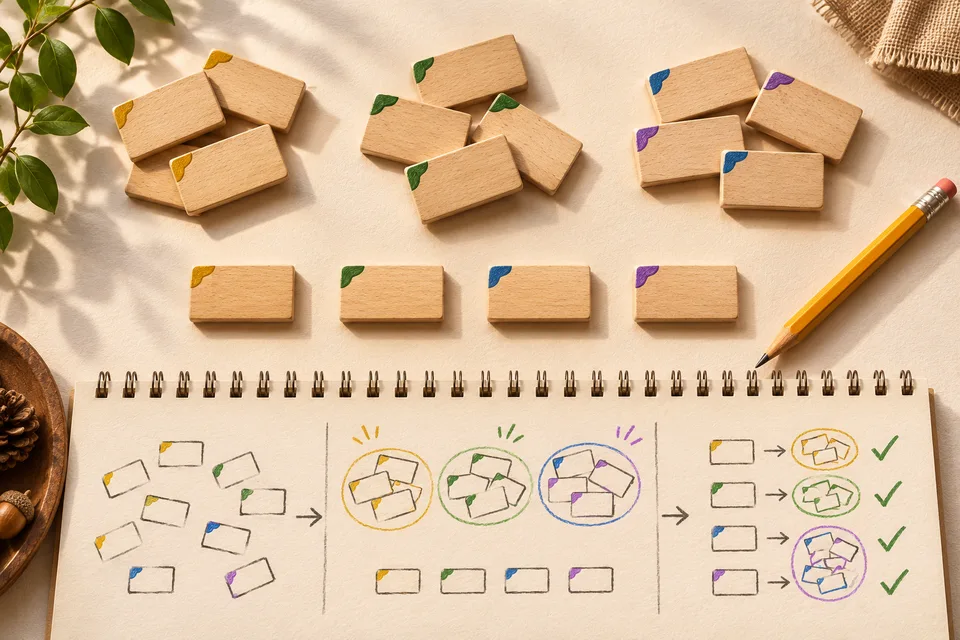
Find an anchor before trying a second meaning
Compare very small quantities in a sentence
In Connections November 23, set aside a candidate if it only fits after a change in spelling or an extra syllable.
A trace of something may be a physical bit you can pick up or a tiny amount of something you cannot touch. In this connection, one candidate may jump out when you picture crumbs on a plate, and another may sound more familiar in a sentence about evidence. Try the candidates in a common frame such as “there wasn’t even a ___ of evidence.” The job is to describe how little is there. That gives the different registers of English a common purpose.
Use an original pair such as speck and whit to see the difference. Very few people would ask for a whit of dust while cleaning a table. Both can help you think about an extremely small amount. Decide whether each candidate serves that purpose in a sensible context before you decide which of them belong together.
Read the navigation screen as a checklist
Picture a journey you are about to start. You open driving directions to understand the path, the timing and the conditions. A useful candidate is a piece of information the display can report. It does not have to stand for a visible object on the road. A person can listen to a spoken instruction, check the length of the trip or notice a delay without ever looking at the places suggested by other words on the board.
Try describing what would change if you took an alternative road. Would this candidate change on the directions screen? That test is useful for distinguishing pieces of information from roadside scenery. Bringing the actual display to mind is more reliable than accepting every word that makes you think of driving.
Look for the parent genre in a music label
The heavy-music connection is easier to check by adding the genre after each label. A candidate that looks like a color or an action can have a precise meaning inside a record collection. Listen for whether the complete label is one a listener would use to describe a sound. A familiar phrase elsewhere on the board may make an attractive first guess. Looking for one shared parent genre helps you decide whether that first meaning was only a distraction.
Find one unmistakable candidate and treat it as the anchor. It gives you a more useful reference than testing four unfamiliar terms at once. Work from that example to the other labels, then check that you have stayed within the same broad musical tradition.
Stop reading at the end of the hidden name
The final connection changes the unit you are reading. Use only the opening letters until they name a young animal. An original sketch such as kitbag can help illustrate the move, because kit can name a young animal while the complete word refers to travel or equipment. Finding such an opening does not require the whole word to be about an animal. Look for a literal match at the start and check where that short word ends.
Read what makes each connection work
yellow connection
The scale is the thing to match. Some candidates sound literary, while others can name a small piece of physical matter. Read each as a quantity and see if you can use it for something abstract such as evidence, patience or sympathy.
green connection
The group is the information on a route screen. It helps you choose a path, estimate when you will get there, and see what could slow you down. Look for interface information rather than for the physical things you might see from a moving car.
blue connection
All four labels identify recognizable styles within the same heavy guitar tradition. A color, a strong verb or a short spelling can each look out of place on its own. If you attach the parent genre, every label points to music rather than to a new metaphor.
purple connection
The group is based on the literal opening letters. A whole word can belong to food, art or another completely different subject and still qualify. Cover the ending and test whether the remaining start is itself a word for a young creature. This is a spelling pattern, so a later matching fragment is a different rule.